
Free cardiology ABIM review sample
Use cardiology review to separate the pattern you recognize from the decision you have to make next.
This free excerpt from For The Boards lets you inspect the layout before buying the printed book. The sample is an excerpt, not the full chapter or a complete board-preparation course.
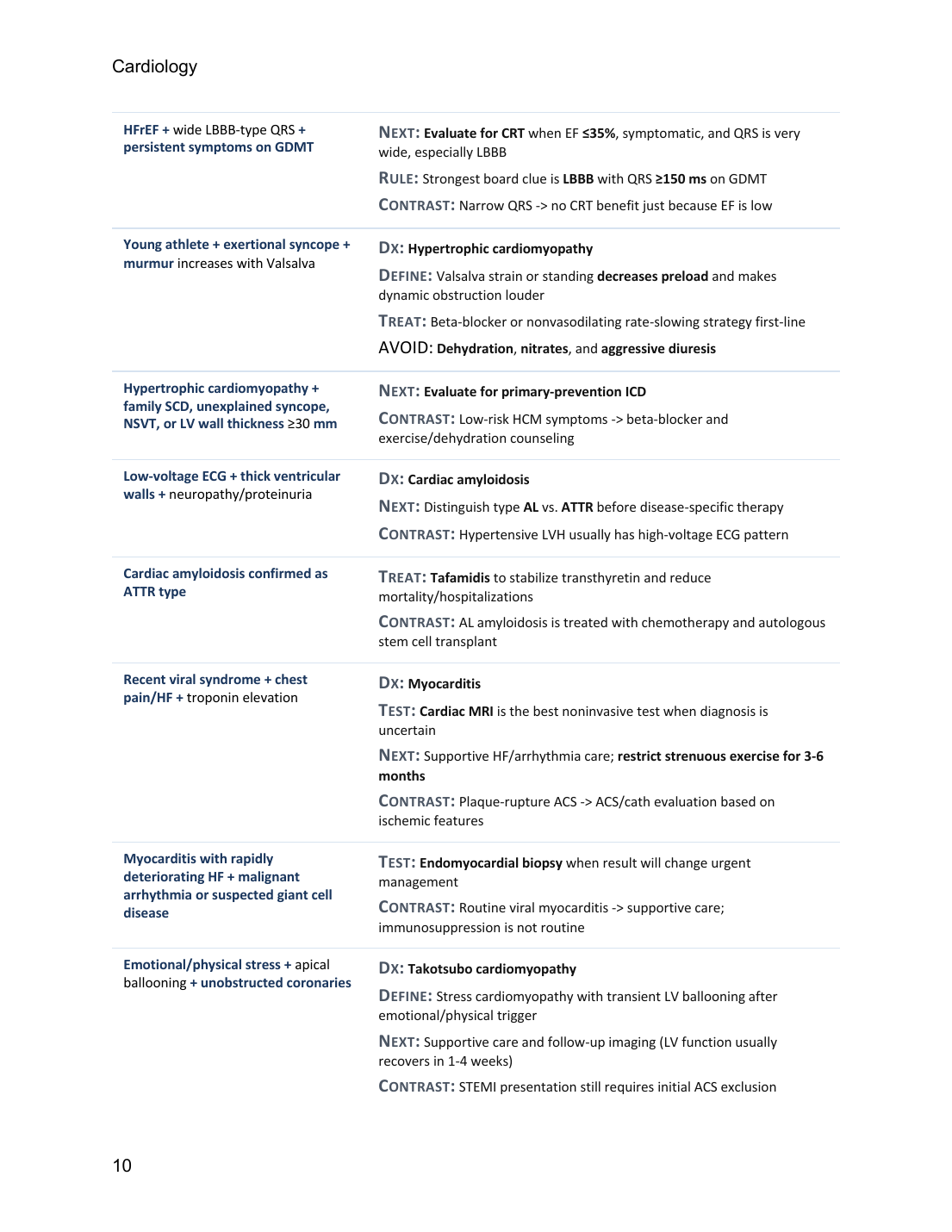
Cardiology questions can feel familiar before you have answered the actual task. You may recognize a presentation but still need to decide which finding matters, what additional information is relevant, or which step comes first. A review note should preserve that distinction.
A short way to review a cardiology question
- Name the task. Are you interpreting a finding, choosing a test, or deciding on management?
- Find the decisive clue. Record the detail that changed your reasoning, rather than every fact in the vignette.
- Compare your alternative. Explain why your first choice did not fit the timing or context.
- Write a retrieval prompt. Make one question you can answer later without the explanation open.
Keep figures and thresholds attached to context
If your source uses a numerical threshold, a risk estimate, or an ECG pattern, note what it applies to. A number without its population, purpose, and source can become misleading when you return to it weeks later. Use your current question-bank explanation and the underlying reference to check the clinical details.
You do not need to copy a whole table into a margin. A brief pointer to the relevant table or figure, plus the distinction you missed, may be enough to guide a later review.
Try the format with one question you missed
Open the sample and look for a related topic. Add a short prompt beside it: the clue you overlooked, the alternative you confused it with, or the decision you want to practice. Leave the full explanation in your source and add a reference so you can return to it.
The book uses compact labels such as Dx, Next, Contrast, and Trap. Use the sample to decide whether that layout helps you organize your own notes. For a step-by-step method, see how to review missed questions.
These study prompts describe a review method, not clinical care instructions. Check diagnostic and treatment details against current references and your educational supervision.
Explore the other samples: Pulmonology · Nephrology. The printed book is $60 with U.S. shipping included.